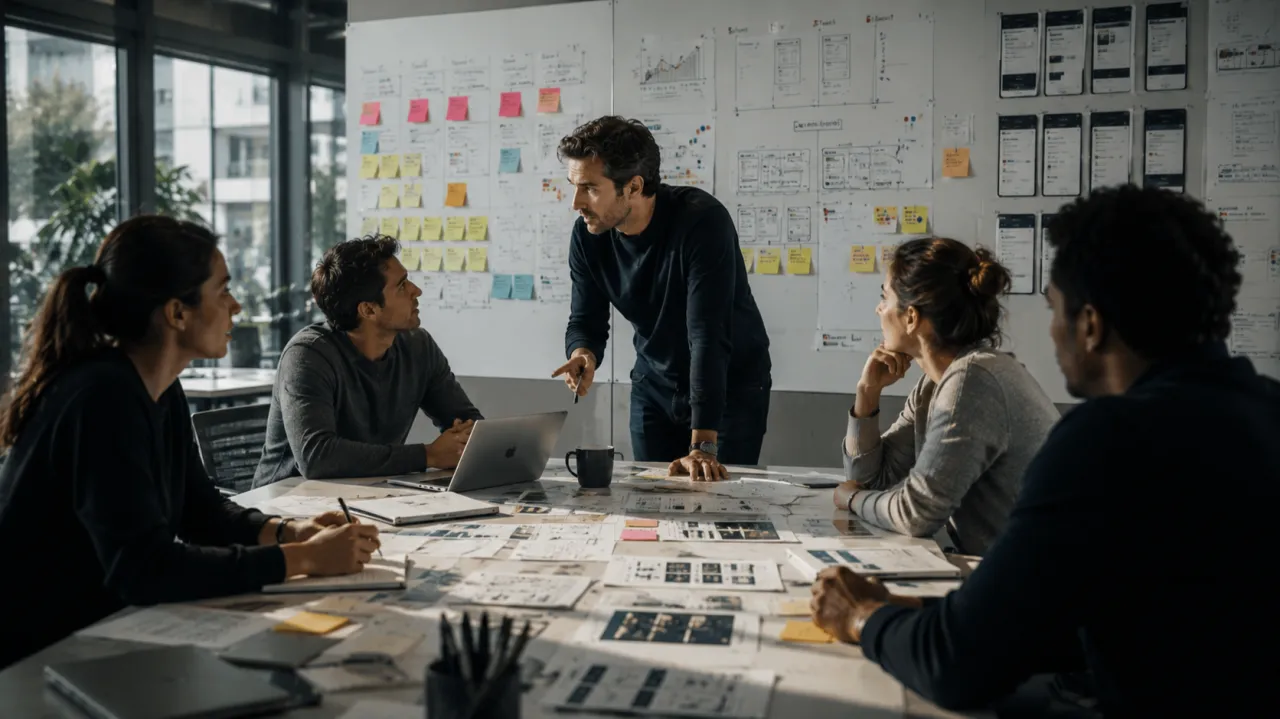

The CIO has folded AI into the Microsoft enterprise agreement. The CTO is piloting Claude Code on a real delivery workflow. Marketing has subscribed to its own AI stack to accelerate content production. Employees are already using ChatGPT to draft reports, emails, and presentations. The board talks about ethics, security, and responsible AI. And outside the company, a new generation of startups is being built almost entirely AI-first.
AI is no longer a future topic. It is already spreading across contracts, teams, workflows, budgets, and everyday work.
The question is no longer whether AI is entering the enterprise. It is whether the enterprise still knows how to organize itself around it.
The previous digital era remained relatively governable because power boundaries were clearer: business teams expressed needs, CIOs governed standards and vendors, CTOs industrialized execution, and software providers expanded step by step across the stack.
That model was not simple, but it was governable.
AI changes that equilibrium.
It becomes much harder to separate business needs from technical design, technology choices from organizational choices, or productivity gains from deeper questions about roles, workflows, decision rights, and scale.
In the AI era, choosing a tool already means choosing a workflow, a capability model, and part of the future organization.
1. From internal build to AI orchestration
Over the last twenty years, companies moved from custom-built digitalization to an API-first world. In the 2000s, many firms had to build internally because the software market was still immature. Over time, ERP, CRM, cloud, collaboration suites, data platforms, and specialized SaaS tools made it easier to externalize capabilities and shift risk, maintenance, and evolution toward vendors.
That shift strengthened the CIO model: governance, sourcing, standardization, and contract management became central levers of transformation.
AI enters this already modular world, but it does something different: it inserts intelligence into the stack itself.
Companies now face two broad paths.
The first is enterprise-led AI integration: extending trusted platforms and incumbent vendors. This path fits procurement logic, governance requirements, and enterprise-wide deployment.
The second is AI-native insertion: introducing copilots, AI coding tools, internal agents, and workflow-native AI much faster, often closer to product, engineering, and business experimentation.
One path optimizes for control. The other for velocity.
The strongest companies will combine both.
As Andrew Ng has argued, real AI transformation starts with pilot projects, internal capability, and broad organizational learning.
Real AI transformation does not start with slogans. It starts with pilot projects, internal capability, and broad organizational learning.
2. AI changes the economics of delivery
AI does not just accelerate software work. It starts to change its production model.
Traditional software production scales mostly through people: internal teams, contractors, offshore capacity, system integrators, sprint planning, and day-rate economics.
AI-augmented production scales differently. A growing part of code generation, prototyping, documentation, testing, and iteration is now driven by tokens, orchestration, and human review.
In software, AI is not just a productivity layer. It is a new production model.
The real shift is not simply that AI writes code faster. It is that the marginal cost of iteration starts to fall sharply. Once that happens, the bottleneck moves away from pure coding and toward framing, architecture, validation, integration, security, and organizational absorption capacity.
This does not eliminate the need for technical talent. But it changes where technical talent creates the most value.
As Sundar Pichai has recently pointed out, AI is already taking a growing role in code generation, pushing human expertise further toward review, judgment, and integration.
As AI reduces the scarcity of some forms of execution, the value of leadership shifts toward judgment, integration, prioritization, and operating model design.
3. AI generalizes technical capability
The digital era progressively embedded more technology into business functions. First came personal computing and office software. Then data tools, BI, workflow systems, automation, and no-code. Then co-design, where business, product, design, data, and engineering started working in tighter loops.
AI pushes this much further.
It allows non-specialists to analyze data, automate tasks, specify workflows, prototype tools, and sometimes even produce code. In that sense, AI generalizes technical capability across the enterprise.
But it does not generalize deep technical mastery.
AI democratizes technical action, but not technical responsibility.
The fact that more people can produce technical outputs does not mean complexity disappears. It means complexity becomes easier to trigger, while still remaining difficult to govern at scale.
That is why the old separation between business expertise and technical expertise becomes less sustainable. The real strategic question is no longer only who can build. It is who can frame, arbitrate, integrate, and govern.
4. AI may personalize what enterprise software had standardized
For decades, enterprise software created scale by standardizing interfaces across desktop, browser, and mobile environments. Enterprises then adapted workflows, training, and roles to those interfaces.
In many ways, the digital era taught organizations to adapt the human to the software.
Fei-Fei Li’s human-centered view of AI is a useful reminder here: the challenge is not only to deploy intelligence, but to design how humans, systems, and institutions will work with it.
AI may change that equation.
Because interaction becomes more contextual and language-based, interfaces can now become more adaptive to roles, tasks, organizations, maturity levels, and even cultural environments. What used to be fixed on the screen may become flexible in the interaction.
This does not remove the need for standards. It relocates them.
In the software era, standardization lived in the visible interface. In the AI era, standardization may move below the interface
— into architecture, APIs, data models, policy layers, security rules, and governance mechanisms — while the user experience becomes more adaptive.
That shift matters. It means companies may be able to keep a coherent core while expressing different interface logics across roles, teams, markets, and cultures.
5. The organization becomes the real battleground
Most companies will discover that AI is easier to test than to scale.
The reason is simple: architecture can be purchased faster than organizational change can be absorbed.
A CIO, a CTO, and a business leader do not optimize for the same thing.
The CIO protects governance, security, procurement fit, and enterprise resilience. The CTO protects velocity, technical leverage, differentiation, and architectural flexibility. The business wants faster delivery, better features, lower friction, and measurable market impact.
These tensions are not signs of dysfunction. They are structural.
And they become sharper with AI because the company can no longer fully silo:
- business need and tech solution
- tool choice and capability design
- process redesign and talent model
- local experimentation and enterprise governance
- interface design and operating model
AI is therefore no longer just a technology question. It is an operating model question.
In many companies, this is becoming a board-level question.
6. Two early signals: Duolingo and Moderna
Public examples of full AI-era organizational redesign are still rare. Most companies communicate on pilots, productivity gains, or tooling. The more interesting cases are the ones that start touching roles, staffing, process design, and scale logic.
Duolingo is one of the clearest startup examples. Its AI-first shift signaled more than a tooling decision. It pointed toward a broader rethinking of hiring, performance logic, contractor usage, and the way functions are expected to work.
That is not just a software story. It is an operating model story.
Duolingo shows what happens when AI starts changing staffing logic.
Moderna is one of the strongest corporate examples. What stands out is not only enterprise-wide AI adoption, but the effort to rethink business processes, employee capability, and the relationship between technology, learning, and the structure of work itself.
Again, the interesting point is not the tool. It is the redesign of the enterprise around the tool.
Moderna shows what happens when AI starts changing enterprise design.
These examples should not be read as final answers. They should be read as early signals.
7. Scale is no longer global by default
There is one more dimension that makes this transformation harder: sovereignty.
For years, global digital scale benefited from a relatively convergent environment: dominant platforms, shared infrastructure assumptions, and the belief that scale mostly meant replication across markets.
That assumption is weakening.
International expansion now happens across moving tectonic plates: data sovereignty, infrastructure dependence, regulatory asymmetry, cultural legitimacy, and competing political expectations around privacy, transparency, accountability, and acceptable automation.
The more AI becomes strategic, the less companies can assume that one architecture, one governance model, and one interface logic will fit every geography.
Global scale used to be mainly an operating challenge. It is increasingly becoming a sovereignty challenge.
In this context, scale is no longer simple replication. It is the disciplined ability to keep a coherent core while adapting to sovereign constraints, local realities, and different cultural expectations.
Conclusion
The next frontier of enterprise AI may not be the model, the tool, or even the stack.
It may be the design of the future organization itself.
The companies that will create durable advantage in the AI era are unlikely to be the ones that simply deploy more copilots or sign more platform deals. They will be the ones able to combine four disciplines at once:
- a scalable architecture
- a credible future operating model
- adaptive interfaces built on governed foundations
- and a sovereignty-aware scale strategy
The next wave of AI case studies will matter less for the tools they deployed than for the organizations they invented.
And in many companies, that is no longer just an IT question.
In 2026, one of the most strategic board questions is no longer whether AI matters, but how the company must reorganize around it.
Originally published on LinkedIn. Join the discussion →